Exploring the strengths and challenges of running Edge Studio's narrative RPG without a Game Master.
Introduction
The image of tabletop role-playing games typically involves a group gathered around a table, with friends laughing, dice clattering, and collaborative stories unfolding. Yet a passionate community of solo RPG practitioners has proven that this experience need not require a group at all. Solo RPGs allow a single person to explore narrative adventures, develop characters, and craft stories entirely on their own.
I have been playing solo ever since my brother passed on, and this is a way for me to honor our history together, the games we played, and the campaigns we had been running since the early 1980s. It gives me a way to check in on "old friends" and see what is up in those worlds again, instead of those feelings of missing something and the longing that comes from losing so much.
Solo play, for me, is a form of therapy, but I would always say: get professional help first and foremost. This doesn't replace that, nor should it be self-medication, but, done in moderation, along with making myself social again and playing games with others, is a balance I seek to maintain as I look back while also moving forward.

Genesys, the narrative-focused RPG system now published by Edge Studio, presents a particularly interesting candidate for solo play. Its story-first design philosophy, flexible narrative dice system, and genre-spanning settings create a foundation that can translate to solitary play, though with important caveats and adaptations.
Let's explore how Genesys performs when played solo, exploring both the compelling strengths that make it a natural fit and the genuine challenges that solo players must overcome.
Understanding Solo RPG Play
Before diving into Genesys specifically, it's worth establishing what "solo RPG" means, as the concept can be misunderstood.
Solo play does not mean playing against the game or simply running pre-written adventures alone. Rather, it involves using various techniques to simulate the functions a Game Master would normally provide:
- Presenting challenges and obstacles
- Resolving NPC motivations and behaviors
- Generating unexpected plot developments
- Providing narrative consequences for player actions
Solo RPG players employ tools ranging from simple random number generators to sophisticated oracles, yes/no engines, and collaborative mechanics that help drive stories forward without a human GM facilitator. The solo player becomes both participant and narrator, making decisions within a framework that maintains surprise, tension, and narrative momentum.
This is distinct from "playing through a module" because the story genuinely responds to player choices; outcomes are not predetermined but emerge from the interaction between player decisions and the system's responses.
Why Genesys Shines for Solo Play
The Narrative Dice System: A Gift to the Solo Player
Genesys's most distinctive feature, its custom dice with symbolic results, is arguably its greatest asset for solo play. Unlike traditional RPGs, where dice simply determine success or failure, Genesys dice produce simultaneous streams of information:
- Success/Failure: Did you accomplish your goal?
- Advantage/Threat: What narrative side-effects occur?
- Triumph/Despair: Critical outcomes that dramatically affect the story
When a solo player rolls, they're not just answering "did my character succeed?" They're generating story material. A failed check with abundant Advantage might mean your character fails their primary objective but gains crucial information, makes a new ally, or notices something important. A successful check with Threat might mean you achieve your goal, but at a cost, such as damaged equipment, a new enemy, or a complication that will surface later.
The special dice, doubling as narrative tools, are the best thing Genesys brings to the table. These give me both good and bad outcomes in rolls that a simple "pass or fail" system (such as 5E) just can't provide with a single d20 roll.

This parallels what an experienced GM does naturally during play: even when a player succeeds, the GM introduces complications. Genesys mechanizes this storytelling instinct, providing solo players with a constant stream of prompts that fuel narrative progression.
The symbolic dice system actively combats writer's block by generating unexpected combinations. You're forced to interpret what "Failure with Triumph and Threat" means in context, and these interpretations become your story. The dice becomes a collaborative partner rather than merely an obstacle.
The "Story Now" Philosophy
Genesys was designed from the ground up around the principle of collaborative storytelling. The rules exist to facilitate narrative rather than to create adversarial win/lose dynamics. This philosophy translates beautifully to solo play because it aligns perfectly with what solo RPG practitioners want: emergent storytelling rather than strategic victory.
In Genesys, the rules support telling interesting stories about characters who face meaningful challenges. There's no implicit assumption that the player must "beat" the module or "win" combat encounters. Success and failure both serve the story.
This matters enormously for solo play. Without a GM to remind everyone at the table that "the goal is fun collaborative storytelling," traditional RPGs can devolve into power gaming or optimization competitions. Genesys's core design resists this by making narrative complexity, represented by Advantage, Threat, and the various special symbols, as valuable as raw success.
Versatile Character Creation with Built-In Story Hooks
Genesys characters are defined by their Career, Skills, Abilities, and Motivation. This framework gives solo players rich material for driving narratives.
The character’s Motivation is particularly valuable. A Strength like "I never forget a favor owed" or "People trust me instinctively" gives your character consistent behavioral patterns that generate a story. A Flaw like "I suspect everyone's motives" or "I take dangerous risks when money is involved" creates automatic complications and conflict. We also have Fears and Desires, which further add to the guidance when playing solo.

When you're playing solo and sitting in the GM chair, you sometimes struggle to know what your character would do in each situation. Genesys's character creation mechanically encodes personality traits that answer these questions for you. Your Flaws create automatic obstacles; you don't need to remember to make things harder for yourself because the system does it.
For example, imagine a solo Genesys character with the Flaw "Obsessed with finding my missing sister." This immediately generates an entire adventure framework. Every location visited, every NPC encountered, every decision made can be filtered through this obsession. The player doesn't have to constantly self-generate motivation; the character framework does it.
Settings: Provide Campaign Frameworks
Genesys's various settings include campaign frameworks, NPC profiles, location descriptions, and adventure hooks. For solo play, these resources serve as a substitute for GM preparation. Instead of needing to create a world from scratch, the solo player can draw from established material while improvising personal touches. The settings function as collaborative worldbuilding partners, offering structure that the solo player can accept, modify, or reject.
This dramatically reduces the cognitive load of solo play. The solo player can focus on their character's story within a framework someone else built, improvising only when they want to depart from the published material.
This is where there is "some assembly required." The core rulebook comes with example settings for the following:
- Fantasy
- Steampunk
- Weird War
- Modern Day
- Science Fiction
- Space Opera
It gives a cursory description of each, with a few pieces of sample gear and some sample opponents. These are not full settings but merely examples of what is possible, so much more work is required to flesh out a complete setting.
It is odd that they split science fiction and space opera, but I get where they are coming from. Science Fiction is more "hard sci-fi" while Space Opera is more "Star Wars."

In the Expanded Player's Guide, we get a few more sample settings:
- Age of Myths (Greek, Roman, Norse)
- Monsterworld (horror)
- Post Apocolypse
They are meant to be examples, and if you want fully detailed settings, check out the Genesys Foundry on DriveThruRPG for an excellent selection of player-created content for the game.
Encourages Creative Interpretation
The narrative dice creates ambiguity that demands creative interpretation. When you roll, you're not simply consulting a table for "what happens next"; you're interpreting symbolic results within context and deciding what they mean narratively.
This active interpretation keeps the solo player engaged in storytelling rather than passive consumption. You're not reading a pre-written adventure; you're co-creating with the system. Genesys's symbolic resolution mechanic ensures this engagement never fully becomes routine, because every roll carries the potential for unexpected narrative turns.
Genuine Challenges for Solo Play
The Absence of Human Collaboration
No matter how well-designed the system, solo play fundamentally lacks what makes traditional RPGs magical: human collaboration. Two or more people interpreting the same fictional space together creates emergent content that no system can fully replicate.
When a GM describes a tavern and a player responds, the resulting scene emerges from both contributions. The player's unexpected question ("Is there a particular smell to this place?") might prompt the GM to add details they'd never have thought of alone. This creative friction produces something genuinely new.
Solo play is necessarily more insular. Your character asks questions you already know the answers to. Your NPCs respond to prompts you generated. The story remains within the space of what you can imagine, bounded by your own creativity rather than expanded by another's unexpected contribution.
Genesys's narrative dice help mitigate this (they introduce genuine surprise), but they cannot fully substitute for a human collaborator whose perspective genuinely differs from yours.
Playing Both Sides: The Immersion Challenge
In traditional play, the GM manages all NPCs, narrates environmental details, and handles off-screen events while players focus on their characters. This division of labor allows players to experience their characters somewhat vicariously, making decisions without full knowledge of what challenges await.
Solo play collapses this division. The player must simultaneously:- Make character decisions
- Determine what challenges exist
- Resolve those challenges
- Interpret NPC responses
- Narrate consequences
- Track all mechanical effects
This creates a peculiar cognitive state. You're constantly stepping outside your character's perspective to handle GM-level information. "Would my character be suspicious of this NPC? Well, I'm also the one playing the NPC, so... yes, I decide she acts suspicious, but do I actually want her to be suspicious, or is that too easy/obvious?"

This meta-positioning can break immersion. Experienced solo RPG practitioners learn to embrace it as part of the format, but it remains fundamentally different from traditional play. Genesys, designed explicitly for immersive collaborative storytelling, sometimes feels the tension here more acutely than more abstract systems might.
Combat Complexity
Genesys combat involves positioning, range, multiple action types, and numerous mechanical modifiers. In group play, one person manages the environment while players focus on their characters' actions. Combat flows naturally with everyone contributing.
Solo combat becomes administratively heavy. You're tracking enemy positions, determining their actions, resolving your character's response, calculating damage, applying conditions, and narrating results; simultaneously.
Many solo practitioners report that combat slows their games to a crawl or becomes unsatisfyingly predictable because they know all the enemy capabilities. Alternatively, combat can feel trivial if the solo player optimizes their character effectively, since no GM is present to calibrate difficulty.
Solutions exist (using simplified combat variants, focusing on social/conflict encounters, or embracing theater-of-mind descriptions over tactical simulation), but they require deliberate effort. Genesys doesn't offer native solo-combat support.
Difficulty Calibration
A skilled GM unconsciously adjusts the difficulty of challenges based on group composition, pacing needs, and dramatic momentum. They might make combat easier if the party had a rough previous session or increase the stakes when the story needs energy.
Solo players lack this intuitive calibration. You're determining difficulty while also hoping to be challenged. It's difficult to be objective about what constitutes an appropriate challenge when you're both the designer and the participant.
Genesys's Difficulty Ranks (Simple, Easy, Average, Hard, Formidable, etc.) provide numerical guidance, but translating them into satisfying gameplay requires practice. Solo players often find themselves either:
- Making things too easy (resulting in boring, tension-free play)
- Making things too hard (resulting in frustrating, failure-heavy narratives)
Neither extreme serves good storytelling. Finding the calibration sweet spot is a learnable skill, but it's one that traditional players develop through GM experience they may not have.
Social Interaction Challenges
RPG sessions often derive their energy from player dynamics: banter between characters, debates over tactics, and role-played arguments that somehow remain fun. These interactions create memorable moments that no solo system can truly replicate.
A solo player in Genesys must simulate social encounters themselves. This can feel awkward, holding a conversation with yourself, giving both sides of an argument, playing the NPC whose help you need while also playing your desperate, hopeful character.
Solo practitioners develop techniques for this (recording prompts, using external oracles, speaking parts aloud to create distance between "my character" and "my NPC"), but the fundamental challenge remains. Genesys's rich social interaction mechanics (Opposition checks, social talents, flavor text generation) work best when there's genuine human otherness on the other side of the conversation.
Motivation
This is one of my challenges. I do not get motivated to play since I feel "nothing will come from it." When I do get a good story going, that is all I want to do, but once I fall off, it is difficult to get started again. Keeping a journal helps me a great deal here, since reading it is instant motivation to continue and also provides a growing story to fill in. If anything, just writing the next page is a tiny goal, and these tiny goals are important for staying motivated.
Practical Approaches for Solo Genesys Play
Despite these challenges, many solo practitioners successfully use Genesys. Their techniques offer guidance:
Oracle-Based Interpretation
Most solo RPG practitioners use external oracle systems—random tables, yes/no engines, or keyword generators—to answer questions the system doesn't resolve. Genesys solo players often supplement the narrative dice with:
- Critical Fate Questions: Asking yes/no questions and using dice results (success/failure on an appropriate check) to answer
- NPC Motivation Tables: Rolling to determine what NPCs want and how they react
- Plot Complication Generators: Using Advantage/Threat results to generate unexpected developments
This bridges the gap between Genesys's built-in narrative generation and the pure GM-substitution that solo play requires.
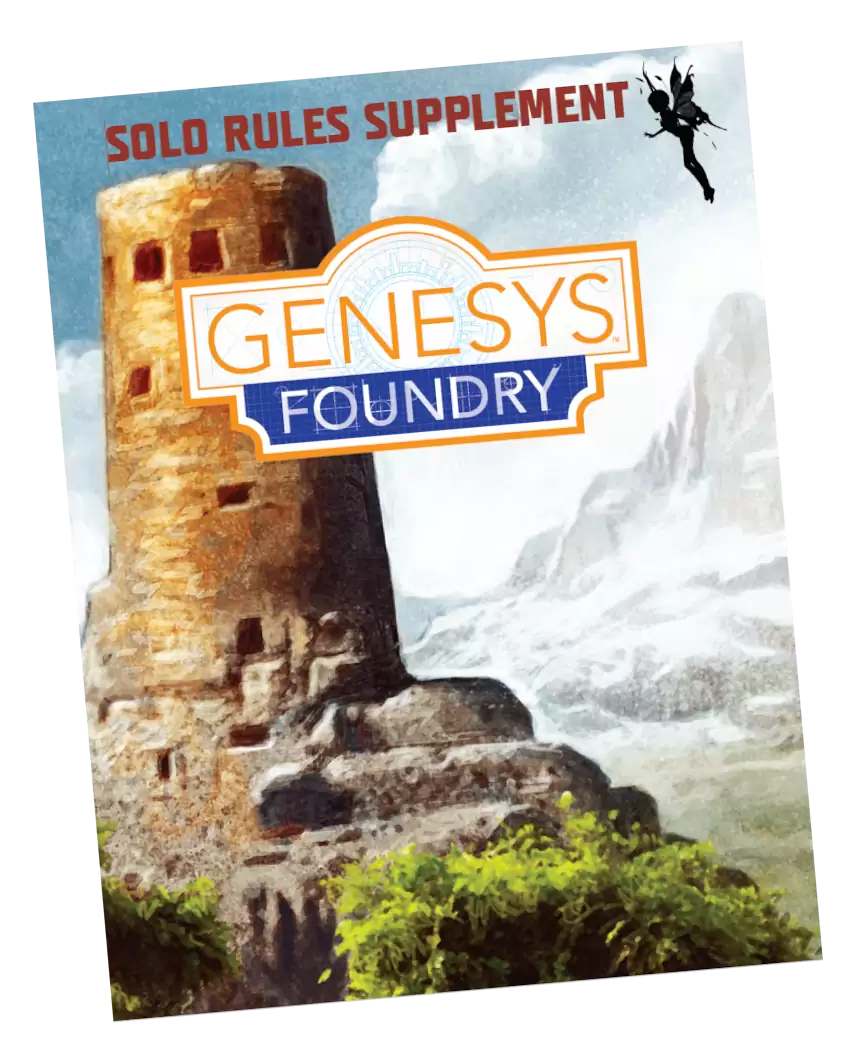
And there are a few solo-play books on DriveThruRPG, specifically tailored to the Genesys system, so please check those out.
Focusing on Narrative Over Optimization
Genesys rewards engaging storytelling rather than mechanical optimization. Solo players who embrace this—and deliberately resist the urge to "build the perfect character"—find more satisfaction. Characters with meaningful Flaws, unexpected Strengths, and complex histories generate better stories than optimized stat blocks.
Solo Genesys becomes most satisfying when approached as interactive fiction rather than strategic gaming. If you're primarily seeking mechanical challenge, traditional RPGs with a human GM will likely satisfy you better. If you're seeking generative storytelling with surprising outcomes, Genesys with solo techniques offers something unique.
Embracing Improvisation Over Planning
Solo play often works best when players adopt a "Yes, And" and “No, But” mindset borrowed from improvisational theater. Rather than planning extensive character backstories or mapping out story arcs, solo Genesys practitioners find value in:
- Creating minimal backstories (just enough to understand motivation)
- Responding authentically to dice results
- Allowing characters to develop through play rather than design
This approach respects Genesys's collaborative nature by leaving room for the system (and its symbolic dice) to contribute unexpected elements.
A Great System for Solo Play
Genesys offers solo RPG practitioners a compelling framework with genuine strengths: a narrative dice system that actively generates story, a philosophy that values interesting outcomes over mechanical victories, and rich setting support that reduces preparation requirements. For players seeking the generative storytelling experience of solo RPGs, it presents a worthy option.
Yet solo play in Genesys requires acknowledgment of its limitations. The system was designed for groups, and its mechanisms assume a collaborative environment that solo play cannot fully replicate. Combat administration grows heavy, immersion faces unique challenges, and calibration becomes a learned skill rather than an automatic system feature.
The question isn't whether Genesys works for solo play; it can, and for some practitioners, it works beautifully. The question is whether the specific experience Genesys offers aligns with what you're seeking.
If you want a storytelling-focused RPG you can engage deeply, developing rich characters and exploring emergent narratives during private sessions, Genesys provides strong tools. Approach it with adaptation, embrace its narrative dice as collaborative partners, and accept that solo play will require different techniques than group play.
If you seek the dynamic human collaboration that makes traditional RPGs magical, no system fully substitutes. Genesys offers an excellent approximation, but approximation implies difference, not identity.
Edge Studio's stewardship of the Genesys line continues, and with it the potential for more official solo support, variant rules, and community resources. For now, solo practitioners have what they need to make it work—technique, creativity, and a system that genuinely wants to tell interesting stories.


